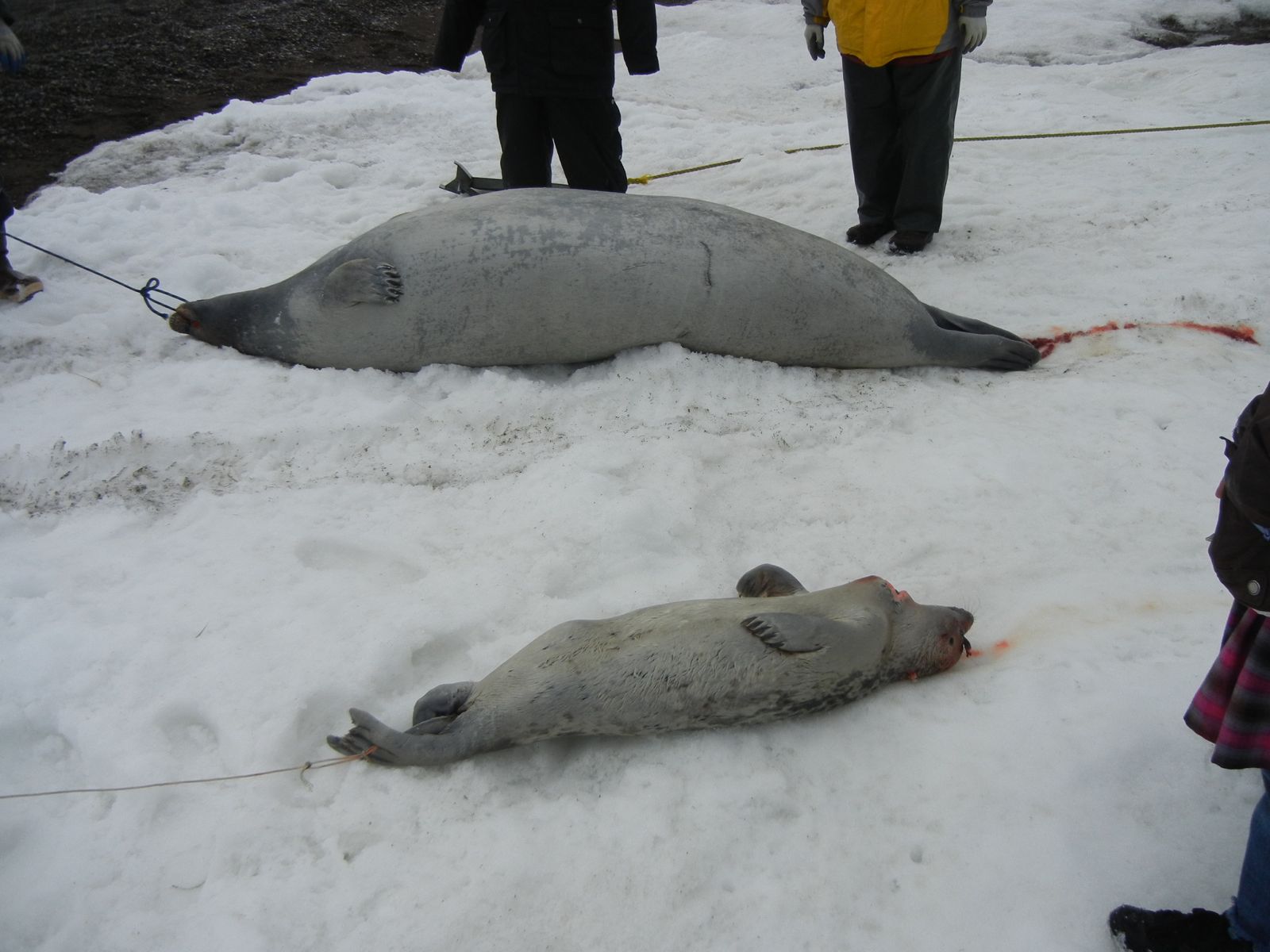
On June 9, Hank took his boat out to go seal hunting. Two of the older fellas who are Iñupiaq (and who have hunting experience) went with him along with one of our fellow campers with no experience. They were gone for about 6 hours and when they returned, they had caught a pretty large ugruk (bearded seal) and a much smaller natchiq.
The next day we all tromped over to the beach to take care of the catch...skin the seals and cut up the meat to divide into shares for the crew. This was, after all, the point of this experience...to be able to participate in the kinds of traditional customs the Iñupiaq take part in when they go to camp each year. It took us awhile to skin the ugruk.
I noticed there were two different techniques that we were using. In one technique, you pulled the skin tightly away from the blubber, then carefully cut the line of skin from the blubber.

The way I learned from Gail (who lives in Point Hope and who was a fellow camper) was to pull the skin tightly away from the blubber, then scrape the skin with short, quick cutting strokes, thus separating the skin from the blubber. The latter technique seemed to go much faster than the former, but it didn't really matter how we were doing it, just that we were doing it.
I understand that the Point Hopers do this much differently from the folks in Barrow. In Point Hope, as you can see, the skin is peeled from the blubber. In Barrow, they cut the skin with the blubber then later separate the two. Since this was my first experience, of course I thought the Point Hope way was the most efficient. It just seems cutting the skin with the blubber, then separating that piece adds an extra step. While the ugruk was being "undressed," some of our crew was also taking care of the natchiq. We were lucky because this was a sunny day, so we didn't get too cold, but it was still a bit chilly.


Everyone had a job to do and rotated in to take part in the work when another became tired. The men, traditionally, do not take part in the piỊak (butchering (think that’s the word) of the seals. They do help with sharpening ulus and lifting entrails out of the seals, though.
I never did find out the "whys" of some of the things we did during the process.
For instance, there was a very focused and curious approach to the preparation of the intestines. Once they were separated from the body of the ugruk, they were cleaned in the ocean (think about how cold that was on the hands! How did she do that without an immediate break for hand warming!) Then the entire

length was braided. I didn't have a chance to ask why. Probably, it's just a good way of storing the miles and miles of intestines? I can say that when we cut up whale intestines during the feast, they were not braided...so I just don't know.

I thought this whole process would make me squeamish and if you know me, you are probably wondering what in the “Sam Hill” I was doing amidst all of this seal hunting. I was in the moment. Maybe it was because we had a job to do, there was a purpose to what we were doing, and I was part of a crew that needed to help with the task we had to accomplish. I think it took us about 4 hours from start to finish, and we were tired.
This was our crew's first catch (just like with the crews that go out whaling, regardless of whether you are in the boat or on land, if you participate in the hunting, catching, preparation, or support of the hunters or preparers, you are part of the crew that receives a share of the catch.) In keeping with tradition, those of us who had never been part of a crew that had caught an animal gave away our share of the ugruk meat. We gave our shares to elders in the village whose husbands, sons, nephews, or others were no longer able to hunt and bring them the traditional foods that they so enjoyed.
But wait, there's more! The umailik who caught the first whale in the spring had also just caught an ugruk that week. His crew were so busy preparing for the whale feast that they didn't have time to piỊak their ugruk (keep in mind, they coordinate the feast among all the umailik's who caught whales. They were feeding about 800 people this week). So, off we hopped on our four wheelers to their "campsite" where we found their ugruk. You are probably wondering just how big these ugruks really are. I mean, it's hard to get a real sense from the pictures.

Well, I've got just the perfect photo as our diminutive instructor posed for a shot so we could show the relative size of the seal. Our instructor is about 5 ft. tall. This ugruk was female and a bit smaller than the male that we had just finished preparing at our site. It only took us about 2 hours to finish preparing this one. In fact, my fellow campers were so enthused to pitch in and finish the job, that I found it difficult to find a place for my ulu.

Lastly, I want to share this photo with you. Notice in the foreground are all of the women of the crew, with ulus in hand, piỊak -ing the ugruk, while the men are seated on the beach...basically watching. Now, you may think 'oh, how typical, the men sit around watching while the women do all the work.' That would be wrong-headed thinking, however. Don't forget, the men did all the work out on the ocean to get the catch to the beach. It is no picnic out on the ice at night or during the day, with or without the threat of polar bears. The division of labor is clear and distinct and fair. The work that the women do is more visible, but they wouldn't have any of those things to do if the men hadn't done their job of catching the animals in the first place.

 When we arrive on the second day of Quaraq, much work has been done to the site. Wind breaks have been erected for the comfort of the participants---and I might add, they were heartily welcomed. Even though it was a partly sunny day, the wind was blowing and it was rather nippy without the protection of the windbreaks.
 This day is marked with blessings from several pastors, once again giving thanks for the bounty and "gift of the whale" bestowed upon the community. The village is a ghost town as the entire community has gathered for the festivities. All of the umailiks speak to the people gathered. Each has a message of humble thanks to God, to their crews, to the community for their support and the message conveying the tradition of sharing with the community. While they are speaking, the wind is gusting and they must project their voices to be heard by the crowd that has gathered. The raspiness in their voices are indicators of the non-stop work they have been involved in during the past week. Consider how exhausted these folks are. They have been preparing for days for the feast and most have gotten little if any sleep. The women have been cooking, the men have either been hunting or most recently constructing the windbreak structures.
 There is much anticipation in the crowd, as there will be distribution of more of the whale harvest. Of note in my observations was the traditional dress worn by several members of the community. Fur parkas, maklaks, and atiqluks were in abundance.

 On this day, each of the whaling crews distribute the meat from the tale of the whales they have caught.
  Before anyone arrived that morning, crew members had delivered the whale tails to the feast site. After the thanksgiving speeches were completed, they broke out their knives and began slicing the tails into individual portions. First of all, take a close look at those knives. They are extremely sharp. We actually found one just like this on the beach last summer. We asked our neighbor what the protocol was in such a find and he basically said, "finders keepers." The crew members work furiously, slicing the tails into individual portions. They must work quickly as the main event on this day is the distribution of the slices to the crowd. It doesn't surprise me how quickly they slices are cut, I noticed this furious workpace last fall when we noted that the three whales caught in Barrow had been totally butchered in the space of 4 hours.
 Once there are ample slices to distribute, the umailiks and their wives call out to the crowd for either individuals or certain groups to come up and get a share. Individuals might be called as they are special friends, respected colleagues, relatives...whatever. Groups included pastors, families, folks who had never caught a whale, folks who had...pretty much anything they thought up. As we had been told by our guides, the protocol was to get your slice and take a bite as you walked back to your seat...showing your appreciation.
 Finally, near the end of the distribution, apples and oranges and sodas were handed out by crew members. These were particularly enjoyed by the children among us!