This day is marked with blessings from several pastors, once again giving thanks for the bounty and "gift of the whale" bestowed upon the community. The village is a ghost town as the entire community has gathered for the festivities. All of the umailiks speak to the people gathered. Each has a message of humble thanks to God, to their crews, to the community for their support and the message conveying the tradition of sharing with the community. While they are speaking, the wind is gusting and they must project their voices to be heard by the crowd that has gathered. The raspiness in their voices are indicators of the non-stop work they have been involved in during the past week. Consider how exhausted these folks are. They have been preparing for days for the feast and most have gotten little if any sleep. The women have been cooking, the men have either been hunting or most recently constructing the windbreak structures.Sunday, July 24, 2011
Moveable Feast
This day is marked with blessings from several pastors, once again giving thanks for the bounty and "gift of the whale" bestowed upon the community. The village is a ghost town as the entire community has gathered for the festivities. All of the umailiks speak to the people gathered. Each has a message of humble thanks to God, to their crews, to the community for their support and the message conveying the tradition of sharing with the community. While they are speaking, the wind is gusting and they must project their voices to be heard by the crowd that has gathered. The raspiness in their voices are indicators of the non-stop work they have been involved in during the past week. Consider how exhausted these folks are. They have been preparing for days for the feast and most have gotten little if any sleep. The women have been cooking, the men have either been hunting or most recently constructing the windbreak structures.Feast Your Eyes On This!
On the first day, one notices that the boats of the umailiks who have caught whales have been brought onto land and placed in a single row with their crew flags flying and paddles tilted upward.
The women on the crews that caught the whales have been hard at work for a good month in preparation for the event. Mikigaq has been cut and marinated. Other pieces of whale meat that will be handed out as Quoq have been cut and stored in the ice cellars.
Maktak has been cut and stored. Hunters have gone back out from the crews that caught the whales in search of other animals to add to the feast. Hunters from all over the village are out in the hope of catching additional food to add to the feast....and they have been successful.
Our instructor mentored us on the proper way to receive our shares. 1. Always carry plenty of ziploc bags. 2. Always have your bag open to receive your share; don't make the giver wait on you. 3. Always make sure you don't miss any of the rounds of distribution. 4. Always say thankyou. Mikigaq is a delicacy truly prized by the Inupiaq. It had a bit of a sweet and sour taste...not bad, but I couldn't quite get used to the texture. Once all of the mikigaq was distributed, that day's activities were over. Time to go home and get ready for the following day.
Saturday, July 23, 2011
The Journey and the Destination
You know how when you are in some kind of life crisis and someone (in my case, it was usually my dad) will say to you, "it's not about the destination, it's about the journey." Well, this field trip we took was about both, in the physical and spiritual sense. 
On the sunniest and warmest day of our camp, we went on a field trip to Cape Thompson. We'd heard about the interesting terrain at Cape Thompson and we could see it from anywhere in Point Hope.
Stevie regaled us with stories about climbing "Suicide Hill" (on fourwheelers) for days prior to our trip. More on that later, but suffice it to say, it sounded like a great trip to me.
We had a caravan of 7 four wheelers. Kind of reminded me of a motorcycle gang going on a long ride. We all got onto our respective rides and headed to town where we got gas. The cost of the gas went on one credit card, so we had to line up in a row, never replacing the pump in between each four
I followed Stevie closely so I wouldn't lose the line and wound up with some cool pictures of our "gang" as they caught up with us. We stopped often to "smell the roses" (as my friend Pausauraq would say). It was a long way out and took about 3 hours, but as we neared the Cape, the sun was warmer and the sky just kept getting bluer.
At one juncture of the trip, we came across a little creek that was kind of deep. Some of the guys scouted out a spot where we could all cross. Turned out, you had to get a running start, blast through the running water and get the four wheeler up a pretty steep bank. I sat on the other side of the crossing watching (with another camper on the back of the four wheeler) while we tried to figure out why we couldn't get our machine in neutral. From across the way, one of the guys yelled over to rock it a little...and that worked. Because of our delay, we were last to make the crossing. No one had made it up the steep bank without help from other folks in getting the machine over the last 6 or so inches of the embankment. Lucky me...all eyes were upon us, the last vehicle to try it (and don't forget, I am a novice rider). Having a somewhat competitive nature
(those who know me are rolling on the floor laughing at that understatement right now), I was plotting how I could clear the bank without assistance...just to show it could be done. I had my fellow camper on the back of my machine, so I did have a little grounding weight. I also had the advantage of less weight in the driver seat than anyone else. So I did what I normally do in these challenging types of situations, I gunned it and closed my eyes! Imagine my delight when I opened my eyes and we had made it to the top of the bank! After a 3 second celebratory cheer, we were off on the rest of our ride.
Imagine riding along an uninhabited stretch of beach with bits of ice floating in the water on a sunny warm day, when all of a sudden you turn to the left toward the mountains and there stands a house...in the middle of nowhere! It's not just any old house, as we find out that Stevie's brother has been a co-builder of this dwelling. How cool is that? We get to explore inside. Clearly thought went into where to place the house and which way it should face in order to reap the benefits of the location. The loft and the carvings inside were truly unique.
![]() |
| Stevie's Brother, Art |
"Suicide Hill" so named for its steepness and unforgiving terrain was the only way to get to our destination. I must relate, our guides and our instructor were a little bit nervous about some of us (okay, me) being able to negotiate the hill.
Our trip was complete with picnic, hot dogs, and s'mores. Some of our campers took this opportunity to claim fame to stepping into the Arctic Ocean. You won't see my picture among them. Though I have walked on the Ocean and in the Ocean (with boots on), I don't find a particular draw to
The meal was relaxed and gave us all time to relax and enjoy our surroundings some more before we headed out. Then it was back to camp in Point Hope. What I found during the trip back, was that I apparently missed the memo that went around that the object of the trip back was to go as fast as you could all the way back. I mean, we were screaming! It was really fun, and even though I did have it set at full throttle, I had the smallest machine and consequently was last most of the way. At one point, I couldn't even see where anyone was...not even their dust. Nonetheless, my rider and I arrived at camp within minutes of the rest of the "gang."
Did Pele Get His Start Here?
![]() |
| Click on the map for a larger view. |
The Iñupiaq call Point Hope, Tigara, a word for the index finger when extended, as that is what the land formation resembles. The old village site is near the point of that spit; the current site is closer to the "fat" part of the land. Just to the east of the village is Jabbertown.
Now, Jabbertown has an interesting history. As Stevie related to us, the commercial whalers had made their way up to Alaska, finding the waters yielded a much more abundant harvest in a fraction of the time it took them to fill their quota as they traveled out of San Francisco, Seattle and other ports.
However, because they had to wait for the sea ice to melt in order to make their trip North, they missed much of the more fruitful hunting season.
So, they decided to move whaling crews up North so they'd already be on site when the whales came through. The whaling crews consisted of a conglomeration of nationalities: Russian, Japanese, EuroAmerican, German, etc. Think about what the mixture of these various languages must have sounded like and you can figure out how the site got its name.
The Jabbertown inhabitants built their sod houses out of driftwood. The Tigaramiut (Point Hopers (miut means people) built their sod houses out of whale bone. As you may expect, you can still see some remnants of the whale bone houses, but the driftwood from the other houses is long gone.
Anthropologists have discovered that in this area, the sod houses had a number of rooms (sometimes 10 or 12) as opposed to the single "family" room in which cooking, eating, and sleeping occurred in the sod houses on the old village site. One could speculate that more people lived in each of these sod
For recreation, the Jabbertown residents and the Point Hopers in the old village played soccer. You will have to try to imagine what this game was like. It was not a soccer field as we know it today. This soccer field was 7 (yes seven) miles long. We speculate that they played a game until someone scored. That was a long way to run, after all, and no way to score within the designated time period we have today. It makes sense that you just played until one of the teams scored. Must have been a heck of a game to watch from the sidelines. The spectators probably got as much exercise as the players (if there were spectators).
Cache Me If You Can
What do you do with all that seal meat? Even with a single share, I had an abundant load.
However, Henry as captain of the boat had a lot more than one could it into a bag or two. He was contributing quite a bit of it to the community whale feast, but needed to store it in the meantime. This provided the perfect opportunity to visit and contribute to the siġḷuaq, or ice cellar.
A note on the word, siġḷuaq. Phonetically, it's "si-ryuk
. It was a new word for me and I'd never seen it spelled. The field trip to the cellar left a big impression on me, and I remembered the word for it even two weeks later. I was able to get the correct spelling from an Iñupiaq colleague. When I'm trying to look up words, I use the online Iñupiaq Dictionary at http://www.alaskool.org/language/dictionaries/inupiaq/dictionary.htm. The trick here is finding the correct English words to use to look up an Inupiaq word. When I typed in ice cellar, I got "piitchuq" (nothing). I needed to put in cold storage, or underground cache to get the correct word. There are different dialects as well, and some words are not the same in the dictionary as those in use in Barrow, but it sure helps to infuse my Iñupiaq vocabulary.
In Barrow, I notice most siġḷuaq are right next door or quite near the person's home, but Henry's is here at the old village site, alongside many others in this area (Henry's house is in the new village site about 5 miles away). Don't forget,
Henry lived here at
the old village site as a little boy. The siglaq is his family's siglaq from that time. Once you've got one of these, I'm thinking you wouldn't just go out and craft another one if you move across town. Just think about it. This is basically a cave carved out of perma frost. Seriously, how long did that take to dig out? And hundreds of years ago, just what did they use to accomplish this, I mean besides the sweat and muscles, what tools did they have to dig with?
We each had a chance to go down and check it out, so we got to see how it's set up with different shelves for storing the whale meat and the seal meat. Storing the meat for a long period gives it a distinctive flavor. Meat that is stored in the ice cellar taking on this characteristic is called quaq.
. It was a new word for me and I'd never seen it spelled. The field trip to the cellar left a big impression on me, and I remembered the word for it even two weeks later. I was able to get the correct spelling from an Iñupiaq colleague. When I'm trying to look up words, I use the online Iñupiaq Dictionary at http://www.alaskool.org/language/dictionaries/inupiaq/dictionary.htm. The trick here is finding the correct English words to use to look up an Inupiaq word. When I typed in ice cellar, I got "piitchuq" (nothing). I needed to put in cold storage, or underground cache to get the correct word. There are different dialects as well, and some words are not the same in the dictionary as those in use in Barrow, but it sure helps to infuse my Iñupiaq vocabulary.
Henry lived here at
the old village site as a little boy. The siglaq is his family's siglaq from that time. Once you've got one of these, I'm thinking you wouldn't just go out and craft another one if you move across town. Just think about it. This is basically a cave carved out of perma frost. Seriously, how long did that take to dig out? And hundreds of years ago, just what did they use to accomplish this, I mean besides the sweat and muscles, what tools did they have to dig with?We each had a chance to go down and check it out, so we got to see how it's set up with different shelves for storing the whale meat and the seal meat. Storing the meat for a long period gives it a distinctive flavor. Meat that is stored in the ice cellar taking on this characteristic is called quaq.
Thursday, July 21, 2011
Ugruk and Natchiq
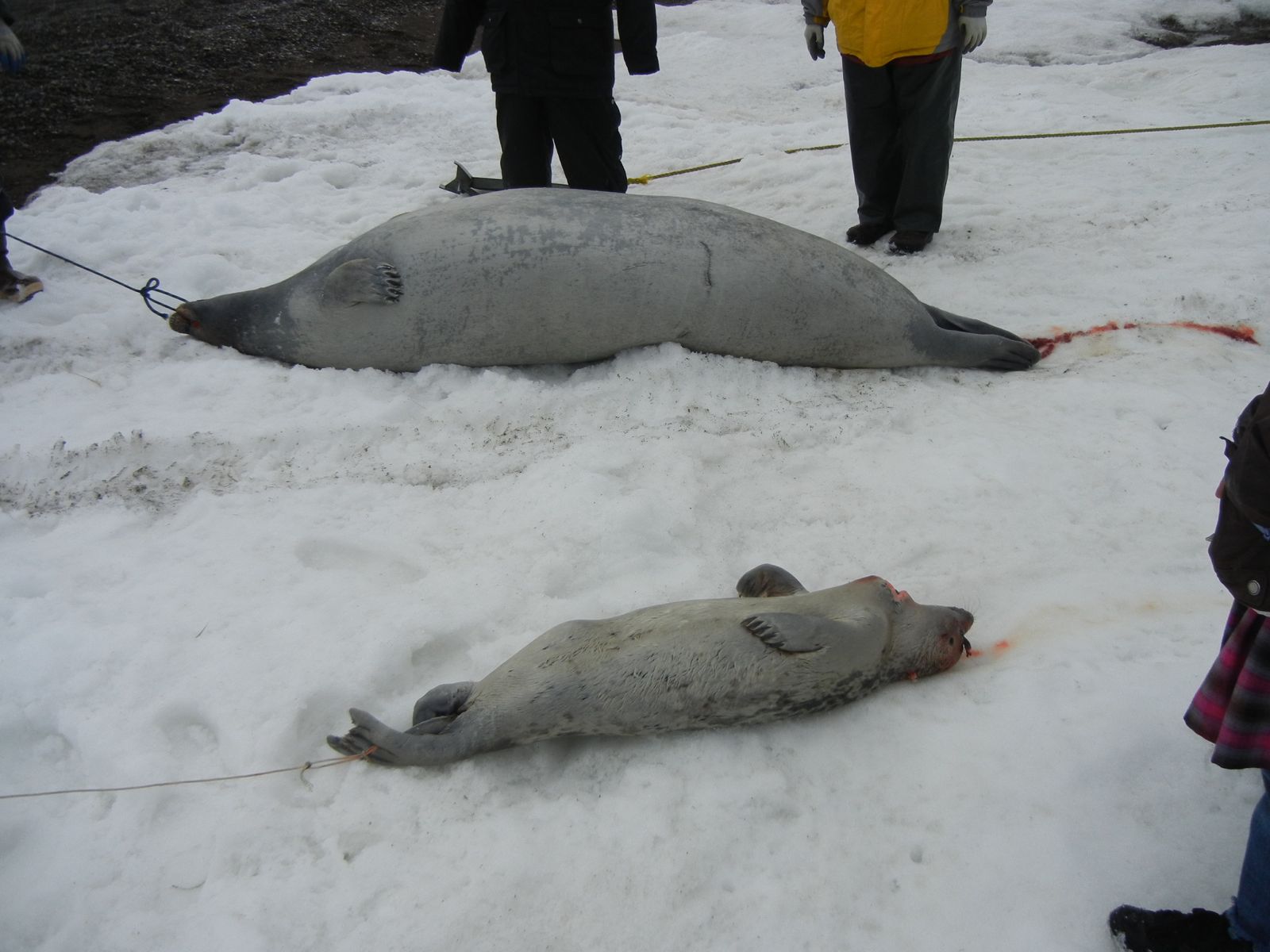
On June 9, Hank took his boat out to go seal hunting. Two of the older fellas who are Iñupiaq (and who have hunting experience) went with him along with one of our fellow campers with no experience. They were gone for about 6 hours and when they returned, they had caught a pretty large ugruk (bearded seal) and a much smaller natchiq.
The next day we all tromped over to the beach to take care of the catch...skin the seals and cut up the meat to divide into shares for the crew. This was, after all, the point of this experience...to be able to participate in the kinds of traditional customs the Iñupiaq take part in when they go to camp each year. It took us awhile to skin the ugruk.
The way I learned from Gail (who lives in Point Hope and who was a fellow camper) was to pull the skin tightly away from the blubber, then scrape the skin with short, quick cutting strokes, thus separating the skin from the blubber. The latter technique seemed to go much faster than the former, but it didn't really matter how we were doing it, just that we were doing it.
I understand that the Point Hopers do this much differently from the folks in Barrow. In Point Hope, as you can see, the skin is peeled from the blubber. In Barrow, they cut the skin with the blubber then later separate the two. Since this was my first experience, of course I thought the Point Hope way was the most efficient. It just seems cutting the skin with the blubber, then separating that piece adds an extra step. While the ugruk was being "undressed," some of our crew was also taking care of the natchiq. We were lucky because this was a sunny day, so we didn't get too cold, but it was still a bit chilly.

Everyone had a job to do and rotated in to take part in the work when another became tired. The men, traditionally, do not take part in the piỊak (butchering (think that’s the word) of the seals. They do help with sharpening ulus and lifting entrails out of the seals, though.
I never did find out the "whys" of some of the things we did during the process. For instance, there was a very focused and curious approach to the preparation of the intestines. Once they were separated from the body of the ugruk, they were cleaned in the ocean (think about how cold that was on the hands! How did she do that without an immediate break for hand warming!) Then the entire
length was braided. I didn't have a chance to ask why. Probably, it's just a good way of storing the miles and miles of intestines? I can say that when we cut up whale intestines during the feast, they were not braided...so I just don't know.
I thought this whole process would make me squeamish and if you know me, you are probably wondering what in the “Sam Hill” I was doing amidst all of this seal hunting. I was in the moment. Maybe it was because we had a job to do, there was a purpose to what we were doing, and I was part of a crew that needed to help with the task we had to accomplish. I think it took us about 4 hours from start to finish, and we were tired.
This was our crew's first catch (just like with the crews that go out whaling, regardless of whether you are in the boat or on land, if you participate in the hunting, catching, preparation, or support of the hunters or preparers, you are part of the crew that receives a share of the catch.) In keeping with tradition, those of us who had never been part of a crew that had caught an animal gave away our share of the ugruk meat. We gave our shares to elders in the village whose husbands, sons, nephews, or others were no longer able to hunt and bring them the traditional foods that they so enjoyed.
But wait, there's more! The umailik who caught the first whale in the spring had also just caught an ugruk that week. His crew were so busy preparing for the whale feast that they didn't have time to piỊak their ugruk (keep in mind, they coordinate the feast among all the umailik's who caught whales. They were feeding about 800 people this week). So, off we hopped on our four wheelers to their "campsite" where we found their ugruk. You are probably wondering just how big these ugruks really are. I mean, it's hard to get a real sense from the pictures.

Well, I've got just the perfect photo as our diminutive instructor posed for a shot so we could show the relative size of the seal. Our instructor is about 5 ft. tall. This ugruk was female and a bit smaller than the male that we had just finished preparing at our site. It only took us about 2 hours to finish preparing this one. In fact, my fellow campers were so enthused to pitch in and finish the job, that I found it difficult to find a place for my ulu.
Lastly, I want to share this photo with you. Notice in the foreground are all of the women of the crew, with ulus in hand, piỊak -ing the ugruk, while the men are seated on the beach...basically watching. Now, you may think 'oh, how typical, the men sit around watching while the women do all the work.' That would be wrong-headed thinking, however. Don't forget, the men did all the work out on the ocean to get the catch to the beach. It is no picnic out on the ice at night or during the day, with or without the threat of polar bears. The division of labor is clear and distinct and fair. The work that the women do is more visible, but they wouldn't have any of those things to do if the men hadn't done their job of catching the animals in the first place.
The next day we all tromped over to the beach to take care of the catch...skin the seals and cut up the meat to divide into shares for the crew. This was, after all, the point of this experience...to be able to participate in the kinds of traditional customs the Iñupiaq take part in when they go to camp each year. It took us awhile to skin the ugruk.
I noticed there were two different techniques that we were using. In one technique, you pulled the skin tightly away from the blubber, then carefully cut the line of skin from the blubber.
I understand that the Point Hopers do this much differently from the folks in Barrow. In Point Hope, as you can see, the skin is peeled from the blubber. In Barrow, they cut the skin with the blubber then later separate the two. Since this was my first experience, of course I thought the Point Hope way was the most efficient. It just seems cutting the skin with the blubber, then separating that piece adds an extra step. While the ugruk was being "undressed," some of our crew was also taking care of the natchiq. We were lucky because this was a sunny day, so we didn't get too cold, but it was still a bit chilly.
Everyone had a job to do and rotated in to take part in the work when another became tired. The men, traditionally, do not take part in the piỊak (butchering (think that’s the word) of the seals. They do help with sharpening ulus and lifting entrails out of the seals, though.
I never did find out the "whys" of some of the things we did during the process. For instance, there was a very focused and curious approach to the preparation of the intestines. Once they were separated from the body of the ugruk, they were cleaned in the ocean (think about how cold that was on the hands! How did she do that without an immediate break for hand warming!) Then the entire
This was our crew's first catch (just like with the crews that go out whaling, regardless of whether you are in the boat or on land, if you participate in the hunting, catching, preparation, or support of the hunters or preparers, you are part of the crew that receives a share of the catch.) In keeping with tradition, those of us who had never been part of a crew that had caught an animal gave away our share of the ugruk meat. We gave our shares to elders in the village whose husbands, sons, nephews, or others were no longer able to hunt and bring them the traditional foods that they so enjoyed.
But wait, there's more! The umailik who caught the first whale in the spring had also just caught an ugruk that week. His crew were so busy preparing for the whale feast that they didn't have time to piỊak their ugruk (keep in mind, they coordinate the feast among all the umailik's who caught whales. They were feeding about 800 people this week). So, off we hopped on our four wheelers to their "campsite" where we found their ugruk. You are probably wondering just how big these ugruks really are. I mean, it's hard to get a real sense from the pictures.
Well, I've got just the perfect photo as our diminutive instructor posed for a shot so we could show the relative size of the seal. Our instructor is about 5 ft. tall. This ugruk was female and a bit smaller than the male that we had just finished preparing at our site. It only took us about 2 hours to finish preparing this one. In fact, my fellow campers were so enthused to pitch in and finish the job, that I found it difficult to find a place for my ulu.
Wednesday, July 20, 2011
The Bowl
Henry is carving driftwood. It's a thick, round piece of driftwood that is transforming from nothing into a traditional bowl. When he's finished, he will donate the bowl to the Inupiaq Heritage Center in Barrow. This kind of bowl was used in the traditional sod houses. The sod houses had an opening in the living area in the ceiling. This let out smoke and provided for fresh air, and sun/moonlight. During a full moon, before the hunt, the umailik's wife would hold a bowl such as this, filled with seal oil, at the sod house ceiling opening. The purpose of this action was make an offering and to ask Amayuk (who lives on the moon and is keeper of all of the animals) for a successful hunt.
The Umailik's Wife
I was captivated by the stories about the actions required of the umailik's wife during the whale hunt. More than once, Stevie reminded us that the whale is the center of their lives. "Without the whale, we would be nothing", he said. So, it stands to reason that the whale, the hunters, the umailiks and their wives are deeply tied to the spirit of the whale.
When a new umailik is named, the wives of elder umailiks go to the house to visit the wife to instruct her on the acceptable practices of the wife during the hunt. To this day, during the hunt, the umailik's wife must abide by certain restrictions in her movements. It is understood that the umailik's wife's movements are mimicked by the whale. The whale essentially becomes the umailik's wife. If the wife gets up suddenly, the whale will jump up suddenly when it is approached. If the wife keeps her movements calm, the whale will approach the umiaq in a smooth and calm manner. If the wife combs her hair (which always causes some hair to fall out) the skin on the whale that is caught will be really thin. The wife is not allowed to cut anything, for this will cause the line on the whale, when caught, to be cut. So she must be careful and follow all of the acceptable practices that are passed on to new wives by elder wives.
The Polar Bear Skin
Hank sleeps on a nanuq skin in the kitchen tent. We all sit on the nanuq when we're in the tent (it is amazingly, but not surprisingly, warm). There are also two pieces of nanuq fur that Hank uses on his four wheeler to keep the driver and passenger a little warmer and more comfortable during trips. I have always felt a particular bond with all bears and love the nanuq skins. At the end of our trip, Hank gifted me with one of the small skins we had used on the fourwheelers. It is important that I make it clear what a huge honor this was. Hank said it was because I helped him particularly in putting away some of the remaining ugruk meat (he was going to do it by himself, and I insisted on helping because I had learned no one ever does a task alone), and again when I helped in making the seal skin rope. He said very few women have ever helped with this task and he thought it was special that I volunteered. These were reasons he gave me for gifting the nanuq skin to me.
During one whaling trip, three boys were in the camp tent while the hunters were out on the edge of the ice. While they were hanging out, one of the boys just happened to take a peek out of the door of the tent. There strolled nanuq, not five feet away! He and the other boys tried to figure out what to do; one of them was only 9 years old. They discovered they only had two knives with them! The two older boys gathered the 9 year old between them and grabbed their knives.
They listened at the tent door for nanuq. They could hear him snuffling around the tent. When they heard nanuq move around to the back of the tent, they, hurried out of the tent, being careful not to attract nanuq's attention and down to the umiaq where the hunters and, more importantly, the rifle was. It turns out that one of those boys was Hank's nephew and he grabbed the rifle from the umiaq. The nephew carefully returned to camp and noticed that nanuq was still hanging around. Nanuq did not seem to want to leave the camping site. So, the nephew wound up shooting the bear. Because it was the nephew's first polar bear, he had to give away his catch (as is the custom for all hunters in the Inupiaq culture). The nephew gave his nanuq to his Uncle Hank, and that is how Hank got the polar bear skin, one piece of which I now have. I will be using it this winter on the vinyl seat of my car to keep my "sitter" warm when it's -40 degrees out.
Atiqs and Umas
Atiq is the person with whom you share the same name; it can be your Inupiaq name, or your English name. Uma is the spouse of your atiq. In Pt. Hope, these are strong relationships. Stevie tells stories of his Uma. Umas take a great interest in their spouses' atiqs. During dances, the atiq always dances with his Uma. The Uma will see the atiq in the store and always go up to greet that atiq and see how s/he is doing.
Stevie tells the story of the day a new preacher came to town. It turned out the preacher was Stevie's atiq, so the preacher's wife was his uma. Around the time of their arrival, Point Hope was having a masquerade dance. The custom for this dance was for the umailiks to set out lots of masks, parkas, and dress up clothes in the front rooms of their houses. The men would come by and use the masks and clothes to disguise themselves for the dance. Participants took great care with the disguises, trying hard to make sure no one would recognize them; they often dressed up in women's parkas and put nylon stockings over their faces. On this night, Stevie put on a red woman's parka. He also put a nylon stocking over his face. Just as he was going out the door, it ripped. He put another one over his face, but that ripped too.
When he finally arrives at the dance, the first thing he sees is his long-time uma ...who just happens to be sitting with his new uma, the preachers wife. So, he approaches them both in character, dancing in front of them and trying to get them to dance with him. He is taken up in the moment and doesn't really realize he is "the devil" approaching his two umas (particularly the preacher's wife). Both umas are frightened and tell him to go away. They do NOT want to dance with him. The next day Stevie sees his new uma in the store and greets her with, "Hi Uma". Thinking back to the night before and the devil who danced in front of her trying to entice her to dance, she carefully considered him and said, "I'm not too sure I want to be YOUR uma"!
Subscribe to:
Posts (Atom)